


Every spring, the USC Rossier School of Education community gathers for the annual Pullias Lecture. Established in 1978 in honor of Professor Earl V. Pullias, the lecture brings a nationally recognized scholar to USC to speak about important issues in education. In April, John B. King Jr., chancellor of the State University of New York, delivered a moving talk, “Higher Education: Engine of Democracy, Security and Upward Mobility,” that focused on the role of higher education in our society. After his remarks, the former U.S. Secretary of Education for President Obama spoke with USC Rossier Dean Pedro Noguera and Pullias Center Co-Director Adrianna Kezar. The three discussed the challenges facing education—from the dismantling of the Department of Education to the high cost of some colleges—and offered words of hope and wisdom to those in attendance.
Pedro Noguera: While you have spoken boldly and plainly about what’s at stake and what your stance is, most of higher ed appears to be trying to lie low, hoping that if they don’t make any noise, then they won’t be a target [of the Trump administration]. Obviously, standing together is a lot more effective than standing alone. How can we get other universities to do more than just capitulate or censor themselves in hopes that the administration won’t target them?
John B. King Jr.: That is the question of our times, right? Institutions are naive if they think that they can successfully bargain with the administration when it has laid out an agenda that is so contrary to our fundamental mission and values. That said, we ought to be clear about where we can agree.
At SUNY, we have no tolerance for antisemitism. We enforce Title VI. I think the Students for Fair Admissions case, which ended race-conscious admissions, was wrongly decided—it reflected a complete misunderstanding of the purpose of the 14th Amendment. However, it is the law, and we’re following it.
Then, when they say, ‘We want you to stop teaching the truth about our history,’ ‘You must give oversight of academic freedom to implementation of our administration values,’ ‘You must stop doing research on health disparities,’ or ‘You have to bow down before a particular ideological agenda,’ we have to say ‘No. That conflicts with our values.’
The federal partnership around research represents a 75-year commitment to how we innovate in health and advanced manufacturing research in America. Everything in your cell phone, many of the treatments that you and your family are receiving from your doctor can be traced back to university research. We’re beginning to see at least the private realization that capitulation is not an option because there’s too much at stake. We will see if people have the courage to say in public what they say in private.
“Everything in your cell phone, many of the treatments that you and your family are receiving from your doctor can be traced back to university research.” —John B. King Jr.
Adrianna Kezar: What’s happening at the federal level with the Department of Education is so troubling. What do you think the impact of these current changes is going to be with the Department of Education? What might be lost, particularly [with regard to] supporting democracy, security and upward mobility?
JBK: It is important to think about what the core functions of the department are, and there are threats in each of four areas.
One, the department’s Title I program sends money to K–12 schools serving low-income students. The Individuals with Disabilities Education Act funding goes to support services for students with disabilities, as well as Title III for English learners and other funding streams that are designed to address long-standing equity gaps. They say they’re not going to disrupt that funding, but they are laying off the very people who are in charge of managing those programs. I worry that without that funding, we will see devastating harm to K–12 schools.
The second major area of work for the department is the Pell Grant program and the federal financial aid system. The Federal Student Aid office was understaffed and underfunded on Jan. 20, but now, it has a lot fewer people. I’m worried about the FAFSA breaking, Pell Grants not being delivered on time and the federal student loan program breaking.
The third area of the department’s work is around civil rights enforcement. A large share of the civil rights complaints are from families of students with disabilities who are not getting the services to which they are entitled. They’re shuttering regional offices and laying off people. Who’s going to investigate those things? This makes you suspect that the real agenda is to undo 50 years of civil rights progress by removing the very mechanisms to enforce protection against discrimination based on race, religion or disability.
The fourth area is data and transparency. We need to know where we’re succeeding and where we’re struggling [in K–12 schools]. In a no-data environment, how do we get better? On the higher ed side, I worry that the elimination of data advances an agenda of steering more money to predatory, for-profit colleges.
PN: This raises another question, which is the vulnerability of higher ed. Increasingly, more young people are questioning the value of college because they are saddled with debt for the next 30 years of their life. What are we doing to make sure that these institutions are accessible to a broad public?
JBK: In 1980, the Pell Grant program covered 80% of the costs of public higher ed. Today, it’s roughly 28%. The erosion of the purchasing power of the Pell Grant program translated into more debt for students. If we don’t fix the underlying problem of how we fund higher education, we will have another generation of students saddled with debt. We should be moving toward a place where public higher education is debt-free for students.
If you choose public higher ed, you should be able to graduate without debt. But we also need to do a better job making sure students graduate. One of the critiques we are vulnerable to is that a lot of students don’t finish. It’s particularly true at community colleges, and it’s disproportionately true at regional publics.
My view is no one starts college thinking, ‘Oh, I’m going to just take a semester’s worth of classes, drop out and have debt and no degree.’ We must have as our intention to put in place the supports that help students complete, if we want to be less vulnerable to the despair around whether college is worth it.
“We should be moving toward a place where public higher education is debt-free for students.” —John B. King Jr.
AK: You spoke earlier about how leaders should respond to attacks on diversity, equity and inclusion. Is there any other advice you would give to people right now?
JBK: We have not done a good job building the kind of evidence base that we need around the impact of DEI programs and initiatives in higher education. That is a problem when we are making the case to people who are persuadable. There’s a set of people who have an ideological view, and I don’t know that we can win them over. But there’s a healthy group of folks in the middle who I think are persuadable, but we must be able to demonstrate the impact.
We say that DEI initiatives result in a greater sense of belonging that causes students to be more likely to persist and complete. We haven’t built the evidence base around that. What does the right training look like that’s going to be effective in moving people to be more open, collaborative, more willing to learn, [and] more tolerant of difference?
PN: It really seems that what this country is suffering from is an amnesia and an unwillingness to confront the past. As a leader who is trying to think about charting these waters, what’s your final message to us? We’re trying not to give in to despair. We’ve been through much worse than this moment. I’m hoping that you can give us something good to hold on to.
“America’s story is a story of expanding the circle of opportunity, the Underground Railroad, the Civil Rights Movement, the women’s suffrage movement and Stonewall. We must draw inspiration from that.” —John B. King Jr.
JBK: We all must try to be very practical about what we can do. Being mad at what you hear on MSNBC and posting on X or Instagram about what you’re mad about is not doing a thing.
We need to figure out what in our individual world we can control and influence—what can we do to be democracy advancing? It is important to figure out what you can do to try to make forward progress so that you can be purposeful and not just overwhelmed by the threats that we face.
The second thing—and I think you’re exactly right, we have seen much worse—we must stay hopeful about the ultimate outcome. President Obama’s would often cite Dr. King’s words that “the arc of the moral universe is long, but it bends toward justice.”
He would talk about that in the sense that we do have this history of two steps forward and one step back. It sometimes feels like two steps forward, three steps back. Yet, in the end, America’s story is a story of expanding the circle of opportunity, the Underground Railroad, the Civil Rights Movement, the women’s suffrage movement and Stonewall. We must draw inspiration from that.
This interview has been edited for length and clarity.
Watch the 46th Annual Pullias Lecture in its entirety:
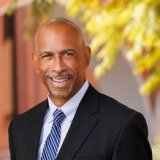
Pedro Noguera
- Distinguished Professor of Education
- Emery Stoops and Joyce King Stoops Dean

Adrianna Kezar
- Dean's Professor of Leadership and Co-director of the Pullias Center
- Wilbur-Kieffer Professor of Higher Education
- Director Pullias Center for Higher Education