



When Jackson Drumgoole EdD ’23 was a freshman at the University of South Carolina, he set out to learn more about his family name. In his research, he came across a man named Father John Christopher Drumgoole, an Irish Catholic priest who founded Mount Loretto, once the largest orphanage in New York and among the largest in the U.S. He also discovered a poet named Will Allen Drumgoole and her most famous poem, “The Bridge Builder.” The poem tells the story of an old man who builds a bridge not so he can use it, but so that those coming up after him can..
While he hasn’t been able to confirm a relation to either Drumgoole, both artifacts of his research—a man who committed his life to helping orphaned children and a poem about the importance of selflessly helping those who come after you—have stayed with him over the decades. They helped inspire him to create Bridge Builder Communities, an initiative that aims to provide safe housing and life skills training to youth aging out of the foster care system.
A destiny to serve
While growing up in Augusta, Ga., Drumgoole witnessed the toll of the foster care system on several family members, and it was an experience that stayed with him. “I knew as a teenager that this was a problem I wanted to solve,” he says. Uncovering the stories of Father John Christopher Drumgoole and Will Allen Drumgoole in his young adulthood further spurred his commitment to make a positive impact on this vulnerable population. When he met his wife, ShDonna Drumgoole, in 2001, on their first date, he shared with her his dream to create an organization that could help prepare foster youth for a better chance of success. Her reply? I want to be the executive director of this organization.
This dream has always been with Drumgoole over the last several decades as he enlisted in the U.S. Army, pursued multiple degrees in various disciplines and raised a family of his own with ShDonna. Reflecting on his 29-and-a-half-year military career and his education, which culminated in a doctorate of education from the USC Rossier School of Education, he says he was trying to become the man and leader equipped to run Bridge Builder Communities.
Drumgoole’s time in the U.S. Army included a decade of service as an intelligence advisor for the National Information and Investigation Agency, Ministry of Interior Government of Iraq, where he worked with leadership personnel, managed a team of civilian and military personnel and mentored Iraqi generals. After that, he took on a variety of leadership roles focused on organizational strategies. Looking back, he reflects that, when it comes to leadership, the Army “looks at leveraging the strengths and talents of everyone around you. Whoever is in charge doesn’t matter,” he says, “you bring everyone and allow everyone agency and choice on how to solve problems.” This diversification—bringing people with different opinions and thoughts to the table—is essential for effective leadership, Drumgoole says, and is an essential element he’s incorporated into his own leadership style.
While pursuing his doctorate at USC Rossier’s EdD in Organizational Change and Leadership program, Drumgoole focused his dissertation research on the power of empathy as a catalyst for change in the lives of vulnerable youth. His work examined innovative approaches to supporting young adults and laid the groundwork for the creation of Bridge Builder Communities, a first-of-its-kind initiative dedicated to helping youth successfully transition into adulthood. One of the things he liked best about the OCL program was its cohort model. He and his peers were already accomplished in their fields, but they all believed they could do more. During the program’s in-person immersions, Drumgoole and his classmates would often discuss what drove them to pursue their doctorate. “We are all strivers, head down thinkers, planners and doers,” Drumgoole says. And “USC,” he says, “gave them the knowledge and credentials to make change.”
One lesson that has stayed with him over the years took place during the program’s first in-person immersion. Professor Doug Lynch asked the students to play tic-tac-toe with one another. After the first game, Lynch then said that in the next game, their job was to help the other person win. This simple inversion of a common game challenged Drumgoole’s thinking and invited him to think about leadership in new ways.
The challenges to Drumgoole’s thinking didn’t stop at this game of tic-tac-toe. Throughout the program, Lynch and other USC Rossier faculty invited him and his peers to combine academia with entrepreneurship and creativity to think differently about common problems. Lynch says it was an honor to teach Drumgoole, and says, “what makes OCL special is neither the curriculum nor the faculty—it’s the cohort. And Jackson represented the very best of it: more talented than he perhaps realized, deeply thoughtful about others, and always inclined toward meaningful action.”
When it came time to begin to bring Bridge Builder Communities from dream to reality, Drumgoole began piecing together the knowledge he had gained throughout his service, work and studies. He started by inviting a wide range of leaders in the Augusta area to a special event, including college presidents, mental health professionals and the city’s sex trafficking task force to brainstorm ways to better support the 11,000+ youth who age out of foster care in the state of Georgia each year. Those present signed a memorandum of understanding, pledging to work together to address the deeply complex issue of improving outcomes for foster youth.
Providing housing to those aging out of foster care was paramount. “Access to adequate housing is a part of human dignity,” Drumgoole explains, and he hopes to create a place where the young adults “can drop their shoulders and relax,” while having access to education, job and life skills training, mental health counseling and a sense of community.

Being a foster child in America
There are currently around 400,000 children in the U.S. in the foster care system. These children, on average, will experience eight different placements throughout their youth. This instability alone is traumatic. The system, Drumgoole explains, is designed to “manage them,” not to love, nurture and prepare them to be successful, contributing members to society.
At age 18, around 20,000 of these children become adults and age out of the system, but despite being seen as a grown person in the eyes of the law, many foster youth are not prepared for life on their own. Many have experienced trauma, including physical abuse, sexual abuse, emotional abuse and medical neglect.
After aging out of the system, between the ages of 19-21, over a quarter of foster youth experience homelessness, one in seven are incarcerated, and one in five become parents. While the foster care system provides youth with a warm bed and meals, Drumgoole explains, the part of “someone being a parent to them and preparing them for life is absent.” There’s a belief, Drumgoole says, that “these are bad kids who don’t deserve a chance,” and the circumstances they find themselves in are somehow their fault. “They’ve missed so much,” he says, and many don’t have “one friend on the planet who wants something for them and not from them.”
Associate Professor of Higher Education and Social Work Royel Johnson, author of From Foster Care to College, which brings together the experiences of 49 foster youth navigating a path to higher education, says, “Young people aging out of foster care are too often asked to navigate adulthood without the family, stability and guidance that many of us take for granted. Housing matters, but what makes Bridge Builder Communities so powerful is that it recognizes housing as only the beginning. Young people also need community, trusted adults, practical support and a real sense that someone is invested in their future.”
Bridge Builders
Drumgoole’s first meeting with stakeholders from across the Augusta region took place in October 2022. Over the past several years, as he’s wrapped up his doctoral studies at USC and continued to work full-time as a director at Wellstar Health Services, he has also been tirelessly working to make Bridge Builder Communities a reality.
While providing stable and safe housing for foster youth who have recently aged out of the system is the foundation of the project, Drumgoole and the coalition of partners know that shelter is only one of their needs. ShDonna Drumgoole, Jackson’s wife, has over 15 years of experience as a social worker and will serve as the organization’s director of programming. Among many wraparound services, the community will provide mental health counseling, both on-site or with a provider of choice, and life skills training that includes everything from financial literacy to cooking classes via the University of Georgia extension program. Medical services, “from dermatology to dental,” will be provided to the residents free of charge, Drumgoole explains. Local companies like Newsome Electrical Construction will provide apprenticeships and on-the-job training.
Every aspect of the project has an intention behind it, including the design of the community itself. Drumgoole knew that a lack of community is one of the problems these youth face, so he decided to design a community consisting of 25 tiny houses, grouped into three pods that face one another. Each pod has some sort of central draw to it—there’s a fire pit in one, an outdoor cooking area in another and a fitness center in the other. He hopes that the residents will move from pod to pod, getting to know their neighbors. And while the community will be a secure and gated one, it is located within another neighborhood and the larger community of Augusta that is already rallying around the organization. Local retirees are eagerly awaiting the arrival of the first residents. This coalition of grandmothers and grandfathers has already prepared 90 quilts for their arrival.
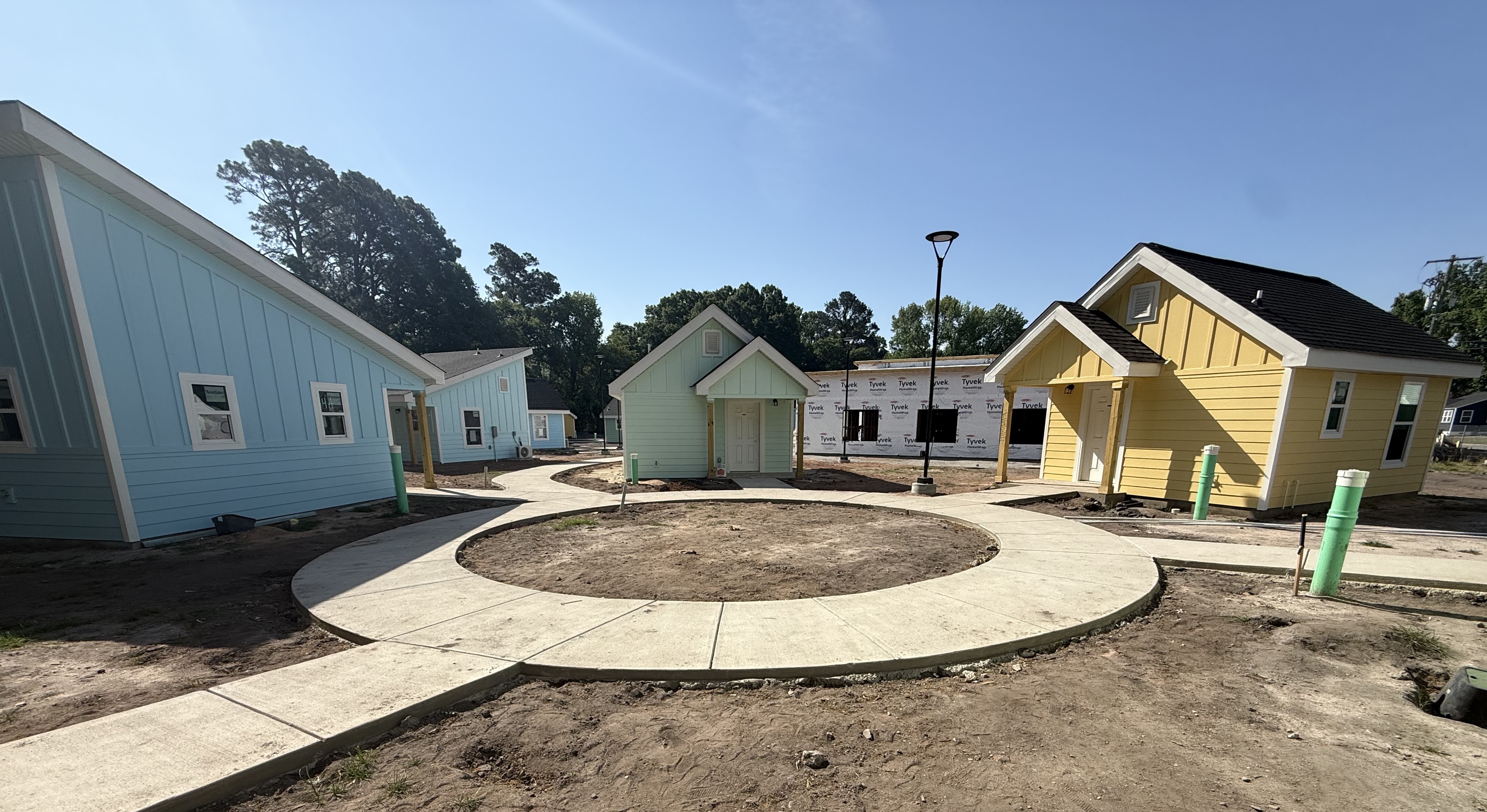
There will also be the manager’s cottage, where the community’s manager will reside, a role Drumgoole compares to a college resident advisor. There will also be a community building where the residents can go to do their laundry, access the variety of services and courses on offer, and lounge and watch movies and play games.
Eventually, as the residents get settled, gain employment and/or enroll in school, they will be responsible for paying rent and utilities on a sliding scale. Drumgoole wants to ensure they are prepared for life beyond Bridge Builders once they age out of this program. He hopes that residents leave with new life skills, employment, a deep sense of community, six months of living expenses in their savings account and a renewed sense of purpose.
The ribbon cutting for the first Bridge Builder Community will take place on Oct. 1, 2026. For Drumgoole, it’s a dream decades in the making. “Long after the ribbon is cut and the cameras are gone, lives will be changed here, Drumgoole says. “This community stands as proof that when a city and a community come together around its most vulnerable young people, hope becomes visible and futures become possible.”