A career as a pop star took Glenn Medeiros around the world until education brought him home.
By the time Glenn Medeiros was 22 years old, he had traveled to about 40 countries. His career as a pop singer had given him the opportunity to see the world and gain an ad hoc education along the way.
After years on the road, Medeiros began preparing for a different kind of career. Enrolling in college later in life “was very easy,” compared to the demands of a career in entertainment that had thrust him into the spotlight as a teenager, he says.
But before his singing career took off and long before he walked across the stage at USC Rossier’s commencement ceremony, Medeiros was just a kid living an ordinary life on the island of Kauai.
“Life was simple,” Medeiros says. He compares growing up in Kauai to “living in the country. We went to the beach and church on Sundays, and on weekdays after school we went fishing,” he says.
Medeiros’s family was close and of modest means—his was the first generation off the sugar plantation.
“My family didn’t put a lot of emphasis on education,” Medeiros recalls. His family emphasized a simple set of goals: get married, try to buy a house, live a simple life and be a good person. “Education,” he says, “was for others.”
But when he was a teen, it was a public school teacher who would end up changing the trajectory of his life.
A music teacher at his school identified his singing talent and encouraged him to pursue it. And while Medeiros was keen to see where his musical talents could take him, he knew then that he also wanted to be an educator.
He put that idea on the back burner as his career took off. He won a local radio competition at the age of 16, singing George Benson’s “Nothing’s Gonna Change My Love for You.” He released the song as a single, and it topped charts across the world. He toured internationally for the next several years.
In his early 20s, Medeiros returned to Hawai‘i, performing at night, while also enrolled in Leeward Community College and later transferred to the University of Hawai‘i in West O‘ahu. After earning his bachelor’s and teaching credential, he soon began teaching special education, fulfilling that early childhood dream to be an educator.
After working for several years in the classroom, Medeiros was asked to train other teachers, and encouraged to serve in an administrative role. He was hired as the vice principal of Maryknoll School in Honolulu, and also started teaching at Chaminade University as an assistant professor, a role Medeiros looks back on fondly, describing it “as the best job I ever had.”
It was during this time that Medeiros set his sights on USC Rossier to strengthen his leadership skills. As he sent off his application, he promised himself that “if USC accepts me as a student, I will take that very seriously.”
After enrolling, Medeiros was thrilled to be learning once again. “The quality of the professors,” he says, “just blew me away.”
Shortly after he graduated with his doctorate in educational leadership, an opening for president became available at Saint Louis School, the oldest all-boys school west of the Mississippi. Medeiros was encouraged to apply, and he’s now been in the position for nearly a dozen years.
Medeiros was well prepared for the position. His dissertation was dedicated to strategies to save Catholic schools in Hawai‘i, which were facing a number of challenges.
When he started, Saint Louis School was $13 million in debt and had only 500 students. More than a decade later, the school is now debt-free and serves 800 students, Medeiros says.
These days, Medeiros is up at 4 a.m. And after a few hours of answering emails, he’s at school by around 6:45 a.m. so he can work the drop-off line. Welcoming students and their families personally to school is an important part of the culture at Saint Louis School, Medeiros says.
His days are then filled with the duties of managing a school—running meetings, overseeing a host of teachers and administrators and meeting with donors and other stakeholders.
In the evenings, Medeiros still performs a few times a week at luaus and other events across O‘ahu. This life he’s created, he says, “is very close to what I wanted.”
How USC Rossier helped Trúc Nguyễn build a career grounded in listening
Before phrases like artificial intelligence and concerns about how children interact with technology dominated headlines, Trúc Nguyễn was already asking difficult questions about how young people navigate the internet.
A research specialist and interim director of General Education at the University of Hawai‘i at Mānoa, Nguyễn has spent years studying online safety and digital citizenship. Over her 20 years at the university, Nguyễn has contributed numerous scholarly articles, presentations and research reports from topics ranging from cyberbullying to online professional development for teachers. It is work she traces back to her time as a master’s student at the University of Hawai‘i at Mānoa, where she earned a master’s degree in educational technology.
Before focusing on education technology, Nguyễn earned a bachelor’s degree in zoology, specializing in marine science and ethology, the study of animal behavior. That scientific training taught her to observe behavior carefully without imposing assumptions. She carried that discipline into her master’s studies in educational technology, where she examined how technology influences people and how people use it for their own purposes. At USC Rossier, she brought those together, moving from describing behavior to considering how research could help communities create change.
Nguyễn’s journey to USC Rossier’s EDL program began with a desire to elevate voices that were not at the table, within her research, she says. She was initially drawn to USC Rossier because of the school’s faculty. She was especially interested in studying with University Professor Emeritus William Tierney and Edward J. Kazlauskas, “because he was looking at technology and education,” Nguyễn says.
Other faculty who attracted her to the EDL program were then-associate dean Melora Sundt, who provided her perspective as a woman leader in higher education; emeritus professor Stuart Gothold and his work with superintendents; and associate professor Linda Hagedorn and her research with Native Hawaiian students. “She did so much work in terms of thinking about how to elevate the voices and the academic achievements [of Native Hawaiians],” she says.
And while the faculty certainly had an impact on her and her research, Nguyễn’s biggest influence was her cohort. Her group was based in Hawai‘i and attended classes in-person but they also spent a summer on-campus at USC. “Being on campus with the professors and with our fellow students and meeting other students in other cohorts…that was an experience that I wouldn’t trade for the world,” she says. The experience of learning together helps make educational leaders more effective, builds a sense of community and brings the concept of the Trojan Family to life for Nguyễn.
When Nguyễn enrolled in the EDL program, she was already an experienced researcher seeking new ways to organize and craft methodologies. The program gave her room to explore perspectives that were often left out of research and deepened her understanding of phenomenology, the philosophical study of structures of consciousness and first-person lived experience. She spent much of her time in the library reading through the stacks and using materials that were not yet widely available online. “Doheny Memorial Library was amazing for me, and being able to observe and talk to the professors about phenomenology and different projects that used phenomenology was good,” she says.
During her studies at USC Rossier, Nguyễn noticed that much of the research on internet safety and digital citizenship centered the voices of teachers, school leaders and technology developers, while student perspectives were largely absent. The realization shaped the direction of her work: She began approaching internet safety and digital citizenship research with the goal of elevating student voice. She wanted to advocate that our responsibility as educators is to include student voice in internet safety rather than form rules based primarily on adult perspectives.
The EDL program provided Nguyễn the opportunity to understand how technology influences people and how people utilize technology. It shaped how she could effect change. Nguyễn asked herself if her idea of change was the right one for the communities she served. Was she listening to the communities and hearing what they wanted to change? The EDL program helped her to understand and to listen more.
Since graduating, Nguyễn has carried that emphasis on listening into research, policy work and professional learning for educators. Across those settings, she sees the work as a connected process: research identifies patterns, policy translates evidence into action and sustained teacher development brings change into classrooms.
That work has become more urgent as young people’s online lives have expanded. “It’s 24-7 and kids have a lot of access,” Nguyễn says. Adults, she argues, must better understand the laws and policies that protect children and take part in shaping flexible technology policy. AI adds new questions about authenticity and self-representation. Although AI tools can be used well, children are still developing the executive function needed to judge whether an AI-generated product genuinely represents their thinking.
Her work with online learning communities has also shown her that professional development succeeds when educators do more than exchange ideas. Participants need to decide what they will accomplish before the next meeting, return with evidence of progress and continue refining their practice. “Learning communities that have that self-engagement, self-accountability and iteration are so critically important,” she says. The same principal guides her approach to teacher training: one-time sessions are not enough; meaningful change requires repeated follow-up.
Nguyễn applies a similar discipline when moving research into policy. Research offers a snapshot, or a series of snapshots that reveal trends, but lawmakers need a concise story they will remember. She distills findings into three points and “mo’olelo,” the story behind the data and what it means for a student or teacher. Her pitch is designed to fit the elevator ride from the parking level of the Hawai‘i State Capitol to the Senate or House floor. She approaches that storytelling with “kuleana,” a deep sense of responsibility, then translates the policy work into teacher learning that can improve classroom practice.
That sense of responsibility extends to the communities at the center of her research. Her cohort members, some of whom are Native Hawaiian, taught her the difference between research done on a community and research conducted with one. Researchers should return what they learn, remain connected and listen before proposing change. “Nothing without us is kind of the mantra,” Nguyễn says. “I take that to heart from my cohort members.”
Reconnecting with USC Rossier alumni in Hawai‘i
In the 1960s, under the leadership of former dean Irving R. Melbo, the USC School of Education established a program to prepare K–12 teachers for the classroom. Soon after, the school launched the state’s first doctoral program in education on O‘ahu in 1966. Decades before the advent of Zoom and online learning, faculty flew from Los Angeles to Hickam Air Force Base and the Japan-America Institute of Management Science to teach the in-person courses.
Glenn Medeiros welcomed guests to the reception (Photo/M. Vidales)
This decades-long relationship has fostered a strong Trojan network throughout Hawai‘i. Today, more than 350 USC Rossier alumni call Hawai‘i home, alongside a vibrant community of approximately 2,000 USC Trojans.
USC Rossier has held regular alumni events in Hawai‘i over the years, and in 2019, the school chose to celebrate its centennial in O‘ahu with special guest Hilda Heine. Heine is a 2014 alumna of USC Rossier’s Doctor of Education in Educational Leadership program and the first woman president of the Marshall Islands.
After years of pandemic-related travel restrictions, USC Rossier returned to O‘ahu on Oct. 10, 2026, for an evening of reconnection and celebration with alumni.
The event took place at the storied Waialae Country Club located in East Honolulu. Against a stunning backdrop of Diamond Head and the Pacific Ocean, alumni reconnected with one another, USC Rossier faculty and Emery Stoops and Joyce King Stoops Pedro A. Noguera.
Glenn Medeiros, a 2014 alumnus of the EdD in educational leadership program and host of the night’s event, kicked off the evening with welcoming remarks. Medeiros serves as president of Saint Louis School in O‘ahu, an all-boys Catholic K–12 school in Honolulu. He introduced Teaching Professor of Education Monique Datta, whom he credits with first encouraging him to apply to USC Rossier.
Professor Datta speaks with reception guests (Photo/M. Vidales)
Professor Datta‘s remarks reflected on how USC Rossier has changed her life as a student, alumna and now as a faculty member. Datta currently teaches in USC Rossier’s Doctor of Education in Educational Leadership and Doctor of Education in Organizational Change and Leadership programs. She has called Hawai‘i home for over twenty years, and has helped keep USC Rossier connected to its students and alumni across the islands.
Dean Noguera then shared remarks. He recounted his upbringing as the son of immigrants in New York City and spoke about his personal connection to Hawai‘i, a special place for him and his family. “We’re thrilled to reconnect with our alumni, and we want to strengthen the SC presence [in Hawai‘i],” Noguera said.
Noguera spoke about the breadth of students and alumni who have always been attracted to USC Rossier, and the alumni network in Hawai‘i is no different. From Mederios, who leads a K–12 school, to Heine, who led a nation, the school’s degree programs attract those interested in leading in a variety of fields, Noguera said.
Noguera highlights several of the school’s new degree programs designed to meet the evolving needs of educational leaders and help aspiring leaders from other sectors deepen their understanding of leadership.
Professor Picus, speaking to attendees here, will retire at the end of this academic year. (Photo/M. Vidales)
In closing, Noguera recognized Professor of Education Larry Picus, who was also in attendance and familiar to many of USC Rossier’s alumni in Hawai‘i.
Professor Picus took the podium to reflect on his USC teaching career and his professional and personal connections to Hawai‘i. After a nearly 40-year career at USC Rossier, Picus will retire at the end of this year. Over the decades, he has taught thousands of students, several of whom were in attendance. By the end of the evening, Picus was adorned with several leis, traditional gifts presented to honor guests in Hawai‘i.
USC Rossier’s history of preparing educators and leaders is closely tied to Hawai‘i’s. On Oct. 10, over 2,500 miles from the USC campus, the distance felt much smaller as alumni gathered to reconnect and celebrate the school’s enduring ties to the islands.
For more information about USC Rossier’s programs, please reach out to Director of Admission and Scholarships Callah Darmali atcdarmali@usc.edu.
USC Rossier alumna Shannon Sakaue found her calling helping community college students find theirs
In the Hawaiian language, the word “Pāhihi” refers to the point on a waterfall where water changes direction. The Pāhihi program at Kapi‘olani Community College in Honolulu supports mature students returning to college — transferring in, returning after time away or attending for the first time as adults. Shannon Sakaue, a counselor and professor at Kapi‘olani Community College, says “The Pāhihi program is where students change their direction, take that leap of faith, and flow out to wherever they’re meant to go,”.
Sakaue’s grandparents on both sides of her family faced varying degrees of hardship after they immigrated to America in the first half of the 20th century. Her Japanese grandparents endured the incarceration camps of the 1940s, and her Chinese grandparents were among the first Chinese families to live in Cupertino. Although neither her grandparents nor her parents had the opportunity to pursue higher education, Sakaue says they all deeply valued it.
Higher education was never up for debate at home. Her parents never asked, “Do you want to do it or not?” Rather, they inquired, “How are you going to do this?”
Sakaue grew up in the Bay Area, where her father worked in technology. After working for many years at a company, her father was laid off. Despite his expertise, the Silicon Valley companies he applied to demanded he have a college degree to even grant him an interview. Sakaue knew then that she never wanted her education to limit her career opportunities.
In 2003, Sakaue graduated from San Diego State with a psychology degree, where an advisor saw her potential and encouraged her to pursue graduate school. Three years later, she followed that up with a master’s in counselor education from San Jose State.
“One thing that kind of tipped me off to counseling is I’ve always been able to connect with people,” says Sakaue. “In high school, I was always the one that all my friends would come to talk to about their problems.”
She put her degrees to use as a college and career counselor at Lincoln High School in the San Jose Unified School District while serving as an adjunct counseling faculty member at Foothill College.
Collectively, her professional experiences served her well when she enrolled in USC Rossier’s doctoral program in 2009. Focused on the higher education administration track, Sakaue took part in two graduate assistantships at USC — one in residential education and another in the Office for the Vice President of Student Affairs.
In the doctoral program, she noticed a difference between herself and her classmates who had spent more time pursuing degrees than in the workforce.
“The ones that were just jamming through school couldn’t contribute to the conversations as much as those of us who had worked,” she says. “The EdD is very applicable. It’s really about how you handle real-life application to real problems in education.”
After completing her coursework, she realized she didn’t need to stay in Los Angeles to complete her dissertation. This inspired her to apply for a counselor position at Kapi‘olani Community College in Hawaiʻi in 2011. Sakaue and her family had vacationed in Hawaiʻi over the years, and it was a place where she “always felt comfortable,” she says.
Inspired to dive deeper into the educational landscape of Hawai‘i, Sakaue’s dissertation explored how Hawaiian, Asian and Pacific Issues courses at Kapi‘olani Community College help students understand and affirm their identities in the local culture of Hawai‘i. The research, completed under the tutelage of her dissertation chair, Professor of Education Darnell Cole, gave her insight into the new educational landscape she was entering.
More than 15 years later, Sakaue has remained at Kapi‘olani Community College, and the decision was intentional. “Community college students have a lot more needs,” Sakaue explains.
After working as a transfer counselor for seven years, Sakaue was tapped to create the Pāhihi program in 2018 to address the needs of returning adult students. It is the only effort of its kind on the 10 campuses that make up the University of Hawai‘i system, she says. Too often, schools largely ignore older learners while enthusiastically welcoming college freshmen.
Hawai‘i’s remoteness presents workforce challenges that can be countered by developing a pipeline of trained and educated professionals in the state, Sakaue says. Though eager to improve their career prospects, returning adult students tend to experience complex emotions — anger, shame, frustration or even joy. Some are in their 30s and have never been to college. Others, Sakaue says, have old transcripts full of D’s and F’s when they were not focused on school.
“It’s like, how much can you handle and maintain a healthy balance?” Sakaue says of her approach to working with students in the program. “Some of it’s just honest conversations.”
Sakaue credits her USC education with giving her the tools to develop the Pāhihi program. “It gave me a lot of ways to look at data, [and] different ways to think about a problem.” Her doctorate has also given her “the confidence to communicate with people on the academic side of the house,” Sakaue says. She can help bridge the gap between faculty and administrators.
Looking back, she sees the small moments that guided her: the fifth-grade teacher who paired her with a special needs student because of her patience, the friends who treated her as if she were a counselor back in high school and the college advisor who recognized her potential before she did.
“People saw certain things in me that I don’t necessarily think I saw in myself,” she says. “So there were just like little God winks along the way that I didn’t know until later.”
Federick Ngo
USC Rossier now enrolling fall 2027 doctoral cohorts for international and independent school leaders
The EdD in Educational Leadership International Schools Cohort is specifically designed for educators working at international, English-medium schools throughout Asia. Current K–12 principals, coordinators, heads of school and other education professionals looking to take the next step in their careers take courses in leadership, foundations of learning, research methods and designing educational organizations for equity and excellence. The course requirements and 43-unit pathway mirror the school’s EdD in Educational Leadership that is offered online, but class content is tailored to students’ experiences at international schools, taking into account specific contexts. Students also learn alongside a cohort of peers working at similar institutions worldwide. “Educators in international schools operate at the intersection of multiple cultures, languages and educational systems. They need a program created for their unique context. This new cohort will receive tailored instruction to meet the needs of those leading and aspiring to lead international, English-medium schools throughout Asia,” says Professor of Clinical Education Cathy Krop, who serves as the faculty governance chair for the school’s EdD in Educational Leadership program. Interested applicants can learn more here.
A similarly structured offering for current and aspiring leaders in independent school settings in the U.S. is available through the EdD in Educational Leadership Independent Schools Cohort. While course requirements and the 43-unit pathway are the same as the existing Educational Leadership program that is offered online, students study their particular independent school context in depth through tailored readings, assignments and other coursework. Professor of Clinical Education Gregory Franklin says, “Leaders in independent schools often face challenges that look different than those in traditional, public systems. Our goal with this new cohort is to bring those leaders together, creating a space that will foster rich dialogue, collaborative problem-solving and a strong peer network.” Students select the K–12 concentration and progress through the degree program with a cohort of peers working in similar contexts, from homeschool to charter school settings. Interested applicants can learn more here.
The school’s Doctor of Education in Organizational Change and Leadership also offers a dedicated International Cohort. Launched in fall 2026, the EdD in Organizational Change and Leadership International Cohort was developed to meet the needs of working professionals in Asia seeking to transform organizations through equity-minded change that centers the human experience. While the focus of the program—building skills to diagnose systems-level challenges and implement effective solutions to drive organizational change—remains the same for the International Cohort. Students also participate in two immersive weekend educational experiences in Singapore. “We designed the International Cohort to meet working professionals where they are, geographically and professionally,” says Professor of Education Courtney Malloy. “By offering courses aligned to their time zones and immersive experiences in their region, we’re bringing the rigorous leadership development that USC Rossier is known for directly to them.” Interested applicants can learn more here.
These three cohorts exemplify USC Rossier’s commitment to making doctoral programs more accessible, flexible and thoughtfully crafted to meet the evolving needs of educators and leaders across the globe. “Education and the way we work and live are rapidly changing, and we need leaders worldwide who are equipped to respond,” says USC Rossier Dean Pedro Noguera. “These new cohorts are grounded in our mission to advance equity, excellence and meaningful transformation and are designed to prepare leaders to address emerging challenges in their particular contexts.”
Applications for all programs are reviewed on a rolling basis. The priority application deadline is December 1, 2026, and the final deadline is July 9, 2027. Applicants are encouraged to apply early.
Doctor of Education in Educational Leadership (EDL) Program Information Webinar
Applying for Graduate School Funding Webinar
What it takes to lead a school district well
For more than five decades, Donald Brann has worked across California’s education landscape as a teacher, principal, superintendent, mentor and advocate for small school districts. Brann, who earned his Bachelor of Science in business administration from the USC Marshall School of Business in 1968 and his doctorate in education from the USC Rossier School of Education in 1982, has led six school districts, including Wiseburn School District, which he attended as a child. Brann also served as an El Segundo city council member, helped launch the Da Vinci Schools charter network, and founded the California Small School Districts Association, which now represents more than 400 member districts.
Along the way, Brann has confronted many of the issues that school leaders face today, including declining enrollment, school closures, contentious school board debates and financial crises. He recently spoke with USC Rossier about the experiences that shaped his approach to leadership, the importance of relationships and what he believes today’s education leaders can learn from the past.
You grew up in Los Angeles and attended California public schools. What do you remember about your early experiences?
I was born in 1945, just as World War II ended, near USC. When I was a boy, we lived near Santa Barbara Avenue, which today is Martin Luther King Jr. Boulevard. We could walk to the Rose Garden and watch the men play horseshoes in Exposition Park. I think at that point, as a young boy, I was destined to someday go to USC.
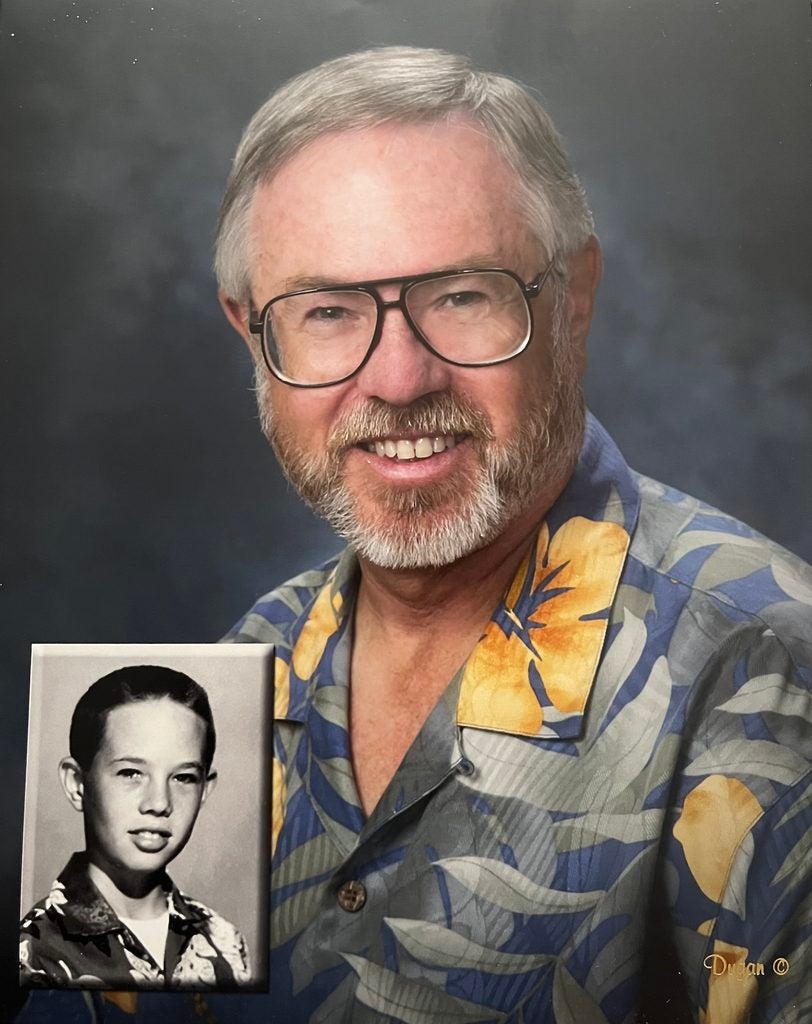
Brann was named superintendent of Wiseburn School District in 1993, the same district he attended as a boy. For his official superintendent photo, he chose to include his eighth-grade school picture (inset). (Photo/Courtesy of Don Brann)
My parents had divorced when I was 2, and I was raised by my mother and grandparents. My mother had been the valedictorian of Manual Arts High School, but for a woman in the early 1940s, during the war, her opportunities were really limited. She never spent a day in college.
We moved to the El Segundo-Hawthorne area when I was 8 because my grandfather and mother had jobs with Douglas Aircraft in El Segundo. I started kindergarten in 1949 at Normandie Avenue Elementary School. In third grade, we moved out to the area near LAX, and I started school in the Wiseburn School District, a little-known K-8 district at the time. Much later, I would come back to lead that district as superintendent.
I went on to Hawthorne High School, where everyone from Wiseburn was slated to go. We had the Wilson brothers in our classes, and they formed the Beach Boys. They went on tour in 1962 and were really unique in their sound.
You met your wife during those years as well?
Yes. She was also a student in Wiseburn, a grade behind me. We started to pay attention to each other around 1961 or 1962. We ended up going together for five years, between my junior and senior year at USC, and we got married at Wayfarers Chapel in Portuguese Bend.
Our marriage outlasted the church itself. We just celebrated 59 years on June 17. She’s been a supporter of mine as I crisscrossed the state to lead these different small districts.
Tell us about your first job in education and your path to the superintendency?
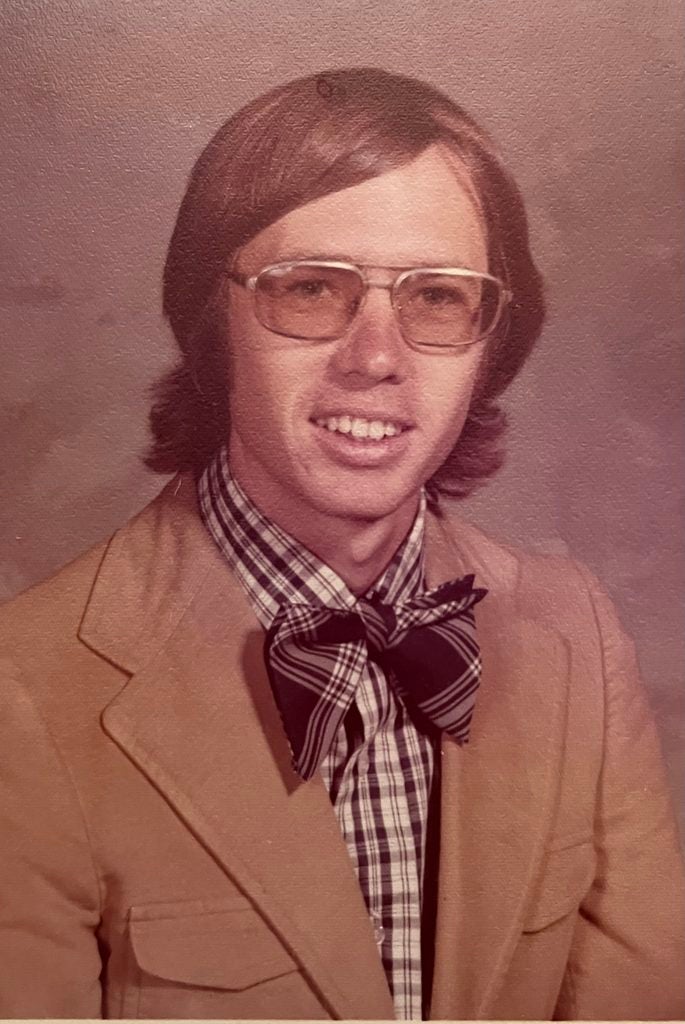
Brann in 1973, shortly after he was appointed as a reading specialist at Center City School in the El Segundo Unified School District. (Photo/Courtesy of Don Brann)
I was a fourth-grade teacher in Room 11 at Center Street Elementary School at El Segundo Unified. After three years, I was named the reading teacher for the school. I pulled kids out of classes who were struggling to learn how to read. Then, in the early to mid-1970s, the state came out with an early childhood education program, and I became a program coordinator for my school.
After nine years with El Segundo, there was a large layoff, and I lost my job in 1979 because I only had nine years of experience, and you needed to have more than 12. That’s when I went out to the desert, between Victorville and Palmdale, and got a K-8 principalship at Wilsona Elementary School.
When I was at Wilsona, the superintendent there was killed in an automobile accident. The board got a petition from the employees of the district, which was only one school at the time, to name me superintendent. The board did it. There I was, like a babe. I was 34, but I looked like I was about 25.
I chose to work in districts that had one, two, three or four schools so that I could know all the employees and the families. Personalization is, to me, the key to success. When you work with others to achieve goals, they see that you’re putting in the work too, that you care, and that you’re not just there for a short stop but that you’re committed.
I founded the Association in 1983. It was for those very small districts all over the state, including rural districts up in Lassen County and Mendocino County, down by the Mexican border and in Imperial County. That group continues today with more than 400 member districts. Most of those districts get no publicity, but many are very successful because they’re very close to families.
Was there an educator who influenced you early in your career?
Dr. Leonard Murdy from the USC School of Education was certainly an influence. I took several classes from him when I was working on my doctorate, and he was the chair of my dissertation committee. He was a key role model and connector for me. He had actually been superintendent in El Segundo, and I stayed in touch with him long after I received my doctorate.
Dr. John Myers was also influential. He was superintendent of El Segundo when I was a teacher there. He showed me what could be possible when I was very young.
I’m a sports guy, so I created my own personal Hall of Fame. I put people in it who inspired me—teachers who were amazing, principals and others. There are only seven or eight people in there. It’s very hard to get in.
You initially studied business at USC. How did that background shape your career in education?
What made my career successful was the marketing and advertising that I focused on in the School of Business and then applied in the public sector.
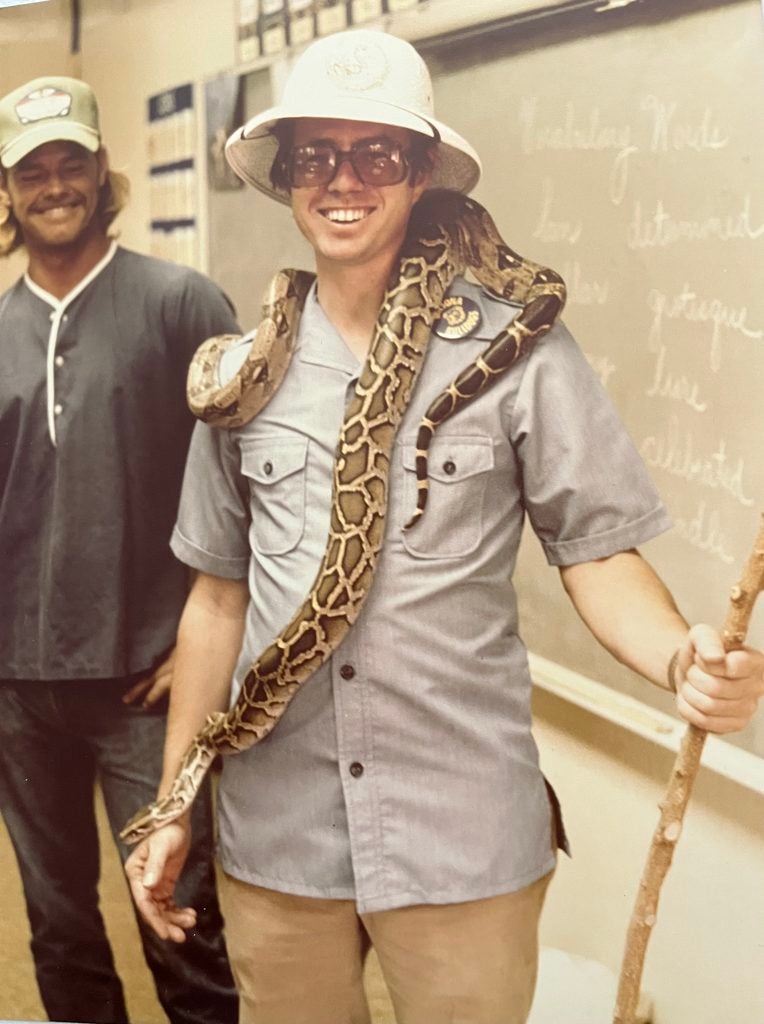
Brann was appointed principal of Wilsona Elementary School in 1979 and describes himself as a “hands-on” type of leader. His students enjoyed seeing him dressed up in his “goofy clothes” for the school’s Halloween Parade. (Photo/Courtesy of Don Brann)
As superintendent of Wiseburn, I decided to address the revenue side of the budget instead of the expenditure side. I wasn’t going to make cuts; I was instead going to raise more money so the budget would balance. I had confidence and faith that the products or services I was selling were going to work.
El Segundo is the aerospace capital of the world and has lots of good jobs. People were commuting into the area. I figured out how I could help these folks who were dying out on the freeways. If I could put their children into schools close to where they worked, I could make their lives work logistically. At some points, as many as 40% of the students were coming in from other places.
When there’s a budget deficit, [superintendents usually] make a list of all the expenditures they can cut, and then they prioritize them. I was able to avoid those kinds of meetings. For the 15 years I was superintendent of Wiseburn, I didn’t cut anything. I kept generating more and more funds until I brought in 1,000 students on permits. That was the secret sauce of how the districts I led thrived.
What advice would you give to education leaders who are facing declining enrollment today?
Keep up with current events and what’s happening in surrounding districts. See what the trends are and what might be an opportunity for your district.
You have to take a lay of the land to figure it out—an environmental scan of what factors might be most advantageous where you are. It’s going to differ, but there’s usually an answer wherever you land, something you could do that people before you didn’t address or even see.
Learning is a lifelong process. We never reach maximum smartness. We just keep growing. That’s what learning is all about.
What led you to pursue your doctorate?
I was a pretty good student, and thought I shouldn’t stop short. I thought it would present opportunities, which it ended up doing.
When I spoke to the graduates of Dana Middle School in Wiseburn when I was their superintendent, I’d say, “I know a lot of you are thinking, ‘Four more years. You only have to do four more years of school, get through high school and you’re good.’”
I would tell them, “Back in 1959, and I might have been thinking that. But I want to tell you how long I was in school after I left here out of eighth grade: 23 years.”
Learning is a lifelong process. We never reach maximum smartness. We just keep growing. That’s what learning is all about.
How did your time at USC influence your approach to leadership?
The cumulative total of my USC coursework shaped me to better understand what the field would be like when I got into it. I learned from other people’s experiences and examples. I’m someone who will listen to experience and try not to make those same mistakes. I benefited from that. All the term papers and work I did at USC became the memos, studies and research I used out in the school districts.
Looking back on your career, was there a particularly rewarding position?
Brann, pictured here in 1983 while he was superintendent of Wilsona School District, during a presentation to one of the district’s classes. Brann says during his time as superintendent at Wilsona he did “just about everything but drive the bus.”
Certainly the opportunity to lead the district where I went to school as a boy. It was a chance to give back to the community where I used to throw newspapers after school. I got to do it for 15 years. I retired from that in 2008, just as I founded the Da Vinci charter schools.
[Before I arrived], the district had gone from 3,000 students to 1,000 and had closed three of its six schools. Somebody like me, with my approach, was golden to the situation. I thought, “Let’s change this. Let’s flip this and rescue it.”
I had a board that was supportive, but they hadn’t hired a teacher in 10 years and were cutting programs and services. I redid that whole district over 15 years. It’s been a really blessed career to be able to touch so many people in such a meaningful way and to send these messengers off into a future that, at some point, I won’t be [part of], but I will have influenced that future through them. That’s the profession of it all: giving to others and sending them out there to reach their potential.
What accomplishment are you most proud of?
Rebuilding all of the schools in the Wiseburn district. I was able to pass four bonds and get about $100 million, and build brand-new schools from scratch. We demolished the original schools and transformed the playground spaces. The board named the newest building in the district after my wife and me.
You faced difficult decisions throughout your career. What experience tested you the most?
Probably the controversy over the calendar when I was in the Old Adobe District in Petaluma. We had two schools on a year-round calendar and two on a traditional calendar, and everybody agreed that a little four-school district with about 1,500 students should just be on one calendar — as long as it was theirs.
That was the problem. I heard from people who wanted the year-round calendar and people who wanted the traditional calendar. Eventually, I recommended a kind of Solomon-like solution, where I split the difference between the two — a longer winter break and longer spring break — and thought it might placate both camps.
The board voted 5-0 to reject it in 1984. The board wanted a traditional calendar, and that’s where we ended up going. The friction from the year-round people was something to deal with, but they saw that I tried to blend it. Thirty years later, that experience has stuck with me.
What have you learned about leading through divisive issues?
I listen to everybody. I want to see what they are thinking and their salient points. Then I determine where that decision is going to be made. In my case, it was at the school board.
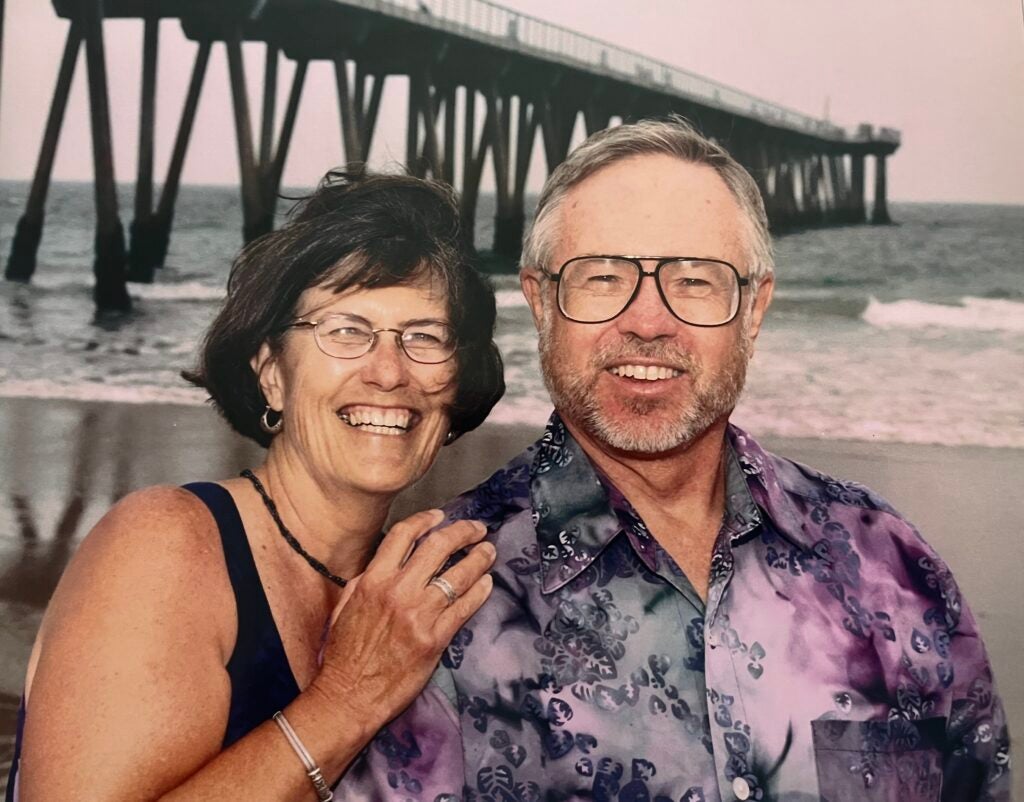
Brann and his wife, Sari Brann, are pictured at the Hermosa Beach Pier in 2004. The two celebrated their 59th wedding anniversary in June 2026. (Photo/Courtesy of Don Brann)
You’re working for the school board, and you have to be able to count to three if you want to continue to be the leader. That doesn’t mean if you lose one issue you’re out, but [if you lose] too many times, you’re going to be out. You want to pay attention to what your bosses want and try to persuade them if you think the arguments of the people who want change are right.
But at the end of the day, you have to go with what the power determines and make the best of it. The important thing is not to discount what others say. Listening and trying to be responsive is always good. People need to feel that you listened to them and that they have a voice.
In 2013, you were also appointed as the state trustee for Inglewood Unified School District during a financial crisis. Can you tell us about that experience?
In 2013, I got the call from the state superintendent, Tom Torlakson. He said, “I’ve been getting a lot of calls about you. Would you be willing to talk to my deputies about leading Inglewood out of bankruptcy?”
After some negotiation, Governor Jerry Brown appointed me to be the state trustee for Inglewood Unified. The board couldn’t vote, so I had the only vote. The district was upside down — $18 million in the red — and they’d gone from 21,000 students to 7,000 students. There was a lot of corruption and people were not necessarily there for the kids.
Two hours after I started the job, the secretary said, “Dr. Brann, the California Highway Patrol (CHP) is on the phone for you.” They told me I didn’t drive anymore and was in the dignitary protection unit, like Governor Brown, Lieutenant Governor Newsom and all the statewide elected officials. Nobody had mentioned any of this when they were recruiting me.
I had to let go of a lot of people who weren’t really coming to work. I worked with Jackie Lacey, the district attorney, to address people who were stealing textbooks and food. I told Torlakson that people thought I was just there for a cup of coffee, that I was going to leave and that they were going to outlast me, but I went in there for the kids. I promised the people there that I was going to see it through and fix it.
By June 2015, I got the budget balanced and got the district $6.6 million in the black. I think it was about a $25 million swing. I was out of there by September. I had done what I had been sent there to do: get the budget balanced. I did that for two and a half, three years. That cured me. That’s the last superintendent job I had.
What advice would you give to current and aspiring superintendents?
It’s a tough job. You’re dealing with unions, the media, special interest groups, parent networks and social media. You’ve got a country where everybody is polarized and can’t find the middle.
Brann was elected to the El Segundo City Council twice, serving from 2008-2012 and again from 2016-2020 after his appointment as state trustee of Inglewood Unified.
I would ask for mentors. I would ask others to help me who are already doing the job. I think they’d be flattered to be asked, and it helps them to think about what they’re doing because some people are doing things so fast that they don’t reflect on why they’re doing it. And you have to have a sense of humor and see the bright side of things.
There’s also so much churning going on, where people aren’t staying in leadership. They’re looking for a way to retire or jump to another district. Those things are not good for students.
Before I got to Wiseburn, I had been superintendent in Wilsona, out in the desert east of Lancaster, for about five years. Then I went up to Petaluma, north of San Francisco in Sonoma County, for about eight years. Then I went to Placerville for two years in El Dorado County.
I got to come back home [to Wiseburn to] pay the community back for the education that my wife and I received there. I decided that if I wanted to make a difference, I had to commit to spending the rest of my career there.
Artificial intelligence is top of mind for many educators. If you were a superintendent today, how would you approach AI in education?
The key is to try to manage it in a way that brings value and doesn’t bring detrimental harm. I just know that, at the end of the day, it’s about the relationships between people. We can never lose sight of that. From relationships, you build trust, and from trust you can get anything done.
AI isn’t going to replace that.
Back in the 1950s, we talked about automation and how jobs were going to be replaced by machines and equipment. We saw that didn’t happen to the degree people expected. We still needed people as part of the equation.
There are always going to be challenges on the horizon. The question is how you adapt to change and don’t let it wreck your existence.
From relationships, you build trust, and from trust you can get anything done.
What gives you hope about the future of education?
What gives me hope is when I see the bright lights of the students and their accomplishments.
I attended my grandson’s high school graduation a couple of weeks ago, and there’s a lot that’s good going on. It’s not necessarily being reported, but it’s there.
This interview has been edited for length and clarity.
‘Hawai‘i has strengthened my belief that leadership is a responsibility, not simply a position’
Monique Datta has taught in USC Rossier’s Doctor of Education in Educational Leadership and Doctor of Education in Organizational Change and Leadership programs since 2013. She teaches a range of courses on leadership, including “Leadership as a Critical Practice,” “Leading for Instructional Excellence and Equity,” and Organizational Change and Communication Practices.” She also serves as a dissertation chair in both programs.
Datta began her teaching career as a secondary teacher, teaching in classrooms in California, South Carolina and Hawai‘i. After earning her doctorate in education from USC Rossier, she then went on to serve as the State Office Resource Teacher for English Language Arts in Hawai‘i. In this role, she worked on teacher professional development programs and state adoption and implementation of the Common Core Standards.
In this interview, she Datta shares how her early years in the classroom influenced her approach to educational leadership, the USC Rossier faculty who have served as lifelong mentors and how her experience living in Hawai‘i has shaped her perspectives on effective leadership.
Were you born and raised in Hawai‘i, or did you come to call the Aloha State home later in life?
I was born and raised in Pasadena, California, and came to call Hawai‘i home later in life. Living and working here has shaped me personally and professionally, especially my understanding of community, relationships, the environment, and cultural responsiveness.
You started your career in education as a classroom teacher. Can you tell us about some of those early experiences and how they have impacted your approach to the field?
I began as a secondary teacher in California, South Carolina, and Hawai‘i. Working with diverse students taught me that effective teaching begins with understanding students, building relationships, and recognizing the strengths and experiences they bring to the classroom.
Those lessons still ground my work with doctoral students and organizational change. I remain focused on how decisions affect people and strive to keep my instruction human-centered.
You earned your doctorate in Educational Leadership from USC Rossier in 2010. What were you hoping to achieve through the program?
I entered the Educational Leadership program to expand my influence beyond the classroom and deepen my understanding of leadership, equity, policy, organizational change and systems that support educators and students.
The program connected research and theory to educators’ practical challenges. It also taught me that education’s “wicked problems” require thoughtful resolutions that evolve with society, technology, and our understanding of humanity. Returning to USC Rossier as a faculty member has made the experience even more meaningful—a dream come true.
Looking back, were there any professors who were particularly influential in your trajectory?
Dr. Larry Picus and my dissertation chair, Dr. Melora Sundt, were especially influential. Dr. Picus deepened my systems perspective on educational leadership, while Dr. Sundt challenged and supported me through the dissertation. Their mentorship continues to shape how I teach and mentor doctoral students.
You have now taught at USC Rossier in the EDL and OCL programs for nearly 14 years. What has been the most rewarding part of your career?
The most rewarding part has been helping experienced professionals become more thoughtful, confident, and critically reflective leaders. It is fulfilling to see students strengthen their ideas, complete their dissertations, earn their doctorates, and create meaningful and equitable change in their organizations and communities.
Chairing dissertations is especially meaningful because the process requires persistence, vulnerability, and growth. Watching students cross the finish line—and later seeing their impact—is a privilege. As I tell them, a PhD is to study the world, whereas an EdD is to change it.
Do you think people in Hawai‘i approach leadership differently? If they do, how so?
Leadership in Hawai‘i is deeply relational. Trust comes not from a title, but through consistency, humility, listening, and commitment to the community. Effective leaders understand people and place and recognize that relationships make meaningful work possible.
There is also a strong sense of collective responsibility. Values such as aloha, mālama, and kuleana call leaders to care for what is entrusted to them and remain accountable to others. No approach represents everyone, but leaders here often recognize that how results are achieved matters as much as the results themselves.
On a similar note, how do you think the educational landscape in Hawai‘i different?
Hawai‘i’s geography, cultural diversity, and statewide public school system create a distinctive educational landscape. Each island community has its own history, strengths, and needs, so leaders must understand the local context rather than rely on a one-size-fits-all approach.
Schools serve students from varied cultural, linguistic, and socioeconomic backgrounds, requiring close attention to equity, access, representation, and culturally responsive practice. As AI transforms education and work, leaders should use it in ways that strengthen learning, relationships, equity, and human connection.
How do you think your experience living in Hawai‘i has impacted your own perspectives on education and leadership?
Living in Hawai‘i has taught me that education and leadership are rooted in relationships, culture, humanity, and the environment. Leaders must listen, understand local history, build trust, and respect the knowledge already within a community.
I describe today’s leadership environment as a “vortex” of social, technological, and environmental change. Leaders may not find perfect solutions to wicked problems, but they can bring people together to develop responsible, humane responses that evolve as conditions change.
Hawai‘i has strengthened my belief that leadership is a responsibility, not simply a position. It requires humility, care, and awareness of how decisions affect people, communities, and the environment. I encourage students to build change with people, keeping humanity at the center.
Join Professor Datta, Dean Pedro Noguera, USC Rossier alumni, students and select faculty on October 10, 2026, for a special reception in Honolulu!RSVP here.
USC Rossier alumnus Darin Brawley EdD ’17 receives the 2026 Harold W. McGraw, Jr. Prize in Education
USC Rossier alumnus Darin Brawley EdD ’17, superintendent of Compton Unified School District (CUSD), has been named a 2026 recipient of the Harold W. McGraw, Jr. Prize in Education in the Pre-K–12 category. The prize, announced by the McGraw Center for Education Leadership at the University of Pennsylvania Graduate School of Education, is one of the field’s most prestigious honors, given to leaders whose vision and perseverance have helped education meet society’s most pressing challenges.
Brawley shares this year’s honor with Shai Reshef, founder of University of the People, and Michael Webber of the University of Texas at Austin, recognized in the higher education and lifelong learning categories, respectively.
Since becoming superintendent of Compton Unified in 2012, Brawley has overseen a dramatic rise in student outcomes, with graduation rates increasing from 58 percent to 94 percent and college acceptance rates surpassing 95 percent in a high-poverty district serving predominantly Black and Latino students. Under his leadership, the district has strengthened instruction, expanded college and career pathways and forged industry and community partnerships connecting students to opportunities beyond the classroom, establishing CUSD as a national model for educational transformation.
While leading this turnaround, Brawley earned his Doctor of Education in Educational Leadership from USC Rossier in 2017. He currently serves on the USC Rossier Board of Councilors.
“Darin Brawley’s work at Compton Unified is proof of what’s possible when a leader commits to a school district for the long haul,” said USC Rossier Dean Pedro Noguera. “This recognition from the McGraw Prize is richly deserved and reflects the kind of leadership our field needs more of.”
Each 2026 winner will be honored at a ceremony on November 10, 2026, in New York City.
Michael O’Neill
For the past 25 years, Michael ONeill, EdD has built a career in higher education leadership. During this time, he has worked in leadership roles which have encompassed a broad range of administrative responsibilities including, but not limited to faculty affairs, budget and finance, human resources, undergraduate & graduate student affairs, enrollment management, space management, and information technology.
Michael O’Neill has taught primarily in USC Rossier’s Doctorate in Organizational Change & Leadership (OCL) program, namely teaching, EDUC-522: Accountability for Organizational Change and EDUC-725: Analyzing Organizational Change and Its Effectiveness since 2021. Michael O’Neill utilizes his experience to bring practical application to the classroom, which is an essential outcome for USC Rossier’s OCL program. In addition to his teaching, Michael O’Neill has been a member for more than 20 dissertation committees.
Michael O’Neill’s doctoral dissertation research explored how generational work value differences influence overall employee job satisfaction. This research has informed his classroom dialog surrounding the practice of accountability and change leadership in the OCL program. He has been able to demonstrate to USC Rossier’s students that you cannot use a one size fits all approach when it comes to ensuring accountability is foundational aspect of your organization.
Doctor of Education in Educational Leadership (EDL) Faculty Concentration Panel
Doctor of Education in Educational Leadership (EDL) Program Information Webinar