
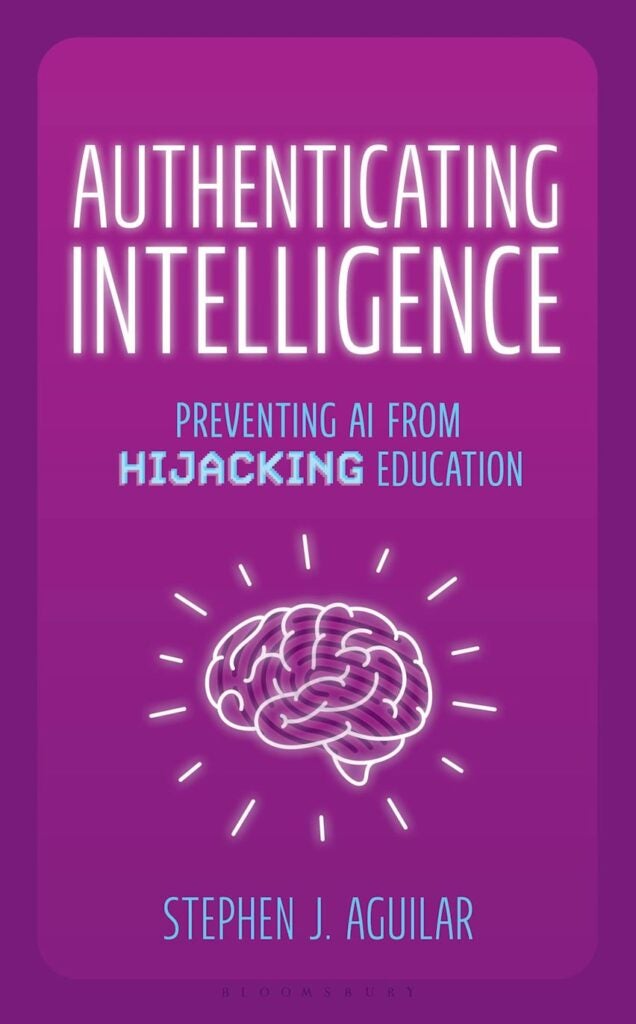
Stephen Aguilar, USC Rossier Associate Professor of Education and associate director of the USC Center for Generative AI and Society, focuses on technology and how children learn from using it. Author of the new book, Authenticating Intelligence: Preventing AI from Hijacking Education, Aguilar discusses why he believes AI represents a “phase shift” rather than a revolution in education, what schools and policymakers tend to overlook when implementing new technology and why he’s concerned that a new wave of untested AI-driven learning models could widen rather than close long-standing equity gaps.
Q: What does it mean to “authenticate intelligence” in a classroom?
AI has caused a crisis in understanding what it means to learn. Do students actually demonstrate what they know, or are they simply turning in what AI spits out? “Authenticating Intelligence” gives teachers, students, policymakers and parents a set of big ideas to help them understand AI’s place in their lives and the educational experiences of students.
Q: You frame AI as a “phase shift” rather than a revolution. Why does that matter?
Claims that AI will let us “reimagine” education are often just marketing. What we learn with has always shifted; classroom TVs in the ’80s, one-to-one iPads in the 2000s, the radio before that. Our institutions are good at absorbing new technology without being upended by it, and that stability is actually a good thing. AI is similar, and it won’t reinvent education the way people think.
That’s why I say that education is like water and has phase shifts. Picture how water can be a solid, a liquid and a gas. All of these phases are still H2O, but different forms yield different experiences. AI is similar. It might change what kids learn with and what teachers use, but it won’t fundamentally change how we learn or the institutions we learn through.
Q: What are educators and policymakers most neglecting?
Whether AI works depends on three inseparable things: the tool, the user and the environment. We tend to ignore that last one. We saw this most clearly during the pandemic. Remote learning during the pandemic failed for predictable reasons; spotty broadband, multiple people sharing bandwidth at home. That’s the environment, not technology or willingness. With AI, we need to ask the same questions: where is it entering, who’s using it and do those pieces actually work together? When they don’t, it’s often a system-level policy problem, the hardest one to fix.
Q: Your digital-divide research shaped real legislation. Is a new equity gap emerging with AI?
Some think AI will naturally improve equity, but technology isn’t policy. Today’s educational inequities are a policy problem. Equity is shaped by how we invest resources and structure access. Tech companies have already created access tiers. There are free models and premium models. Paid tiers are more capable. Businesses have access to near-cutting-edge tools, yet even there, the true cutting-edge technology is still owned by a few companies. That’s the nature of tech development within capitalism, so it’s best to be honest about what tech will and won’t enable.
So while equity and technology are linked, they don’t move together. In fact, the real risk is a flood of untested, unproven AI tools. We already see this happening with models like Alpha School. The notion that a laptop paired with an AI tool and a roaming “guide” are sufficient for a flourishing educational experience is ludicrous. Learning happens in the community with or without technology. Yet, untested models keep gaining traction anyway because too many people have become enamored with AI.
Q: You describe yourself as a “tempered optimist” on AI. What does that mean?
While writing Authenticating Intelligence, I kept circling back to one question: should we be afraid of AI, or should we embrace it uncritically? I decided that neither was the answer. A “tempered optimist” is a person who is optimistic but willing to ask hard questions and hold people accountable to prove their claims of efficacy when it comes to AI.
Parents and educators shouldn’t fear AI. They should find where it genuinely helps, which will differ by task and person. That’s a personal decision, made with your institution, not a reason for fear or reflexive pushback. Look at the evidence. Demand it. Then decide.


