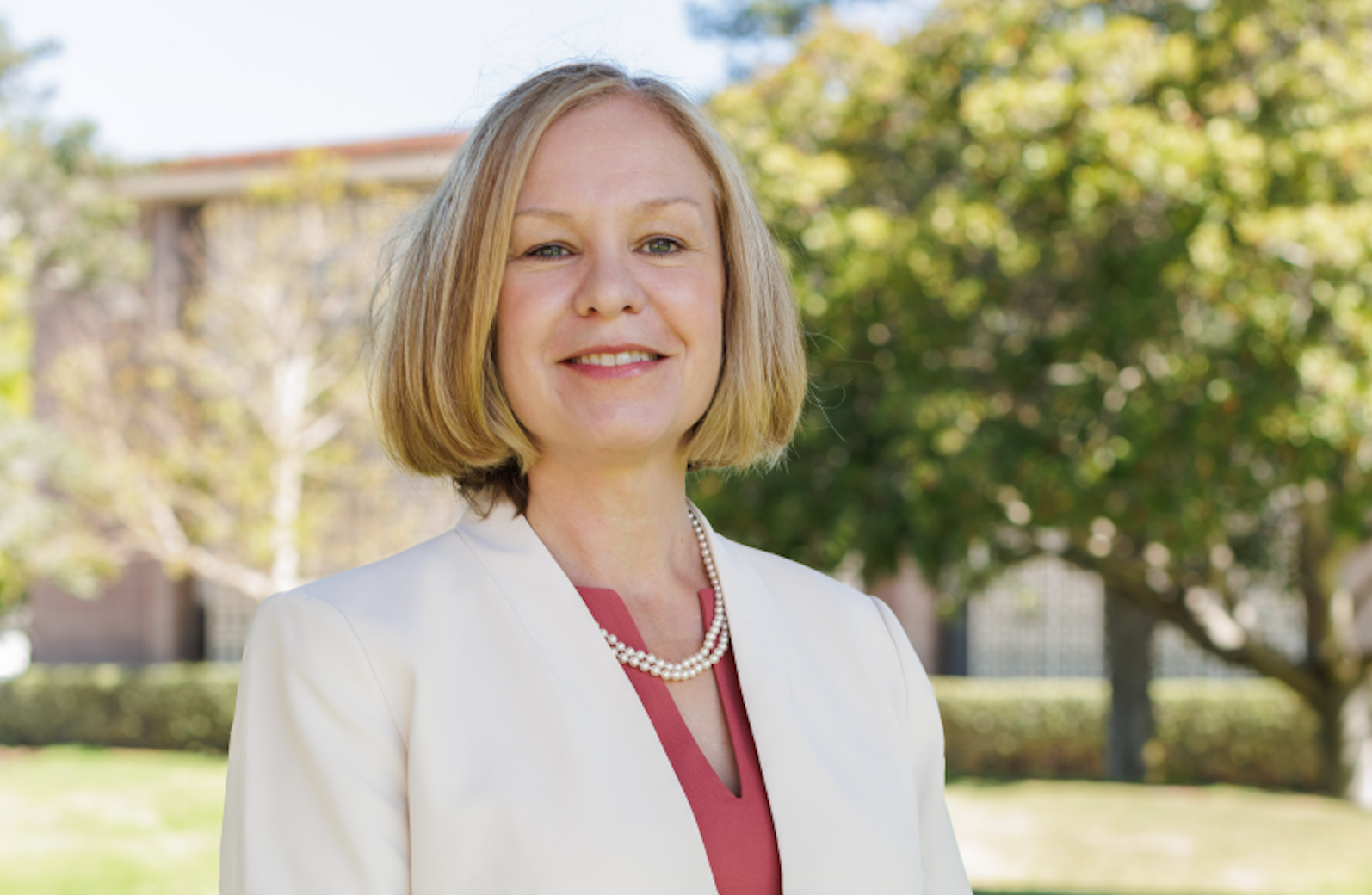
For Jaime Lester, in choosing the USC Rossier School of Education as the institution where she would expand her knowledge about higher education and leadership, the decision was an easy one. “USC became the place where I began to see higher education not just as a field I wanted to work in, but as something I wanted to understand deeply and help shape,” says Lester.
Lester, who received both her master’s and PhD degrees from the USC Rossier School of Education, was recently named dean at the Gevirtz Graduate School of Education at the University of California, Santa Barbara.
Lester began her university studies as an undergraduate at the University of Michigan. There, she had the unique opportunity to co-teach a course. This experience exposed her to the complex nature of students’ needs and the entire profession of student affairs and was fundamental to her discovering what a career in higher education might look like. “I was amazed that one could get a job in a college and never leave!” says Lester.
Lester knew that she wanted to have a career in higher ed, and that led her to USC Rossier. As she was still discovering what her options were in higher education, the Master of Education in Postsecondary Administration and Student Affairs program at USC Rossier appealed to her because “it offered an opportunity to study higher education not simply as a set of institutions, but as a complex social system shaped by questions of leadership, organizational change, equity, policy and the experiences of students and faculty.”
Lester joined USC Rossier and the Pullias Center as a master’s student, working side-by-side with then-associate professor Linda Hagedorn on community college student success. She learned the value of research-practice partnerships through collaborating with local community colleges on disseminating knowledge across institutions.
USC Rossier and its intellectual environment stood out to Lester because it encouraged her to think critically about why individuals and organizations are resistant to change and the effectiveness of good leadership.
“Working in that environment taught me how to ask better questions, how to collaborate with others on complex research, and perhaps most importantly, how to think about research in terms of its implications for institutional practice and change,” said Lester.
She later had the opportunity to collaborate with Adrianna Kezar, Dean’s Professor of Leadership, as a student in USC Rossier’s PhD in Education program, with Kezar serving as her dissertation chair. Their relationship has endured beyond Lester’s time at USC and well into her experience as a scholar and a higher education leader.
“Jaime has been one of the foremost scholars of community colleges, leadership and organizational issues in higher education before becoming a leader herself, spanning a variety of progressive leadership roles,” says Kezar.
Since earning her PhD at USC Rossier, Lester has taught and held leadership positions at several universities, including George Mason University and Johns Hopkins University, where she served as vice dean of the School of Education. Lester has also contributed more than 50 peer-reviewed publications.
Lester has continued to collaborate with Kezar throughout her career. The pair co-authored two books together, Organizing Higher Education for Collaboration: A Guide for Campus Leadersand Enhancing Campus Capacity for Leadership: An Examination of Grassroots Leaders in Higher Education.
Lester has emphasized the influence that Kezar had on her as a mentor, helping her understand the importance of having a genuine commitment to improving higher education.
“I learned the importance of looking beneath the surface of an organizational problem and asking what conditions are producing it and what kinds of leadership might actually enable meaningful change,” said Lester.
Kezar, as well, commends Jaime for the immense growth that she has had toward becoming a key leader.
“She represents one of the best examples of people moving from scholar into practitioner—and using the data and wisdom from her earlier work to support inspired leadership for the campuses that she has been at,” said Kezar. “I’m so proud of her latest leadership as dean of the graduate school of education at UC Santa Barbara.”
Jaime Lester’s transition from a scholar to a leader has taught her about the importance of creating conditions for leadership to work together for their common goals. Years after her time at the Pullias Center, she still returns to the lessons she learned there as a student.
“In many ways, I am still working on the same questions I studied at the Pullias Center—how organizations change, the role of equity within change and the impact of positional and non-positional leadership,” said Lester. The lessons that she learned at USC go hand-in-hand with how she spearheads change throughout educational institutions and will serve her well in her new role at UC Santa Barbara.


