

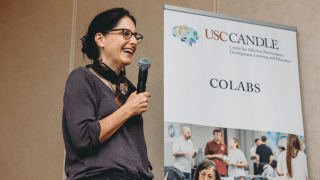
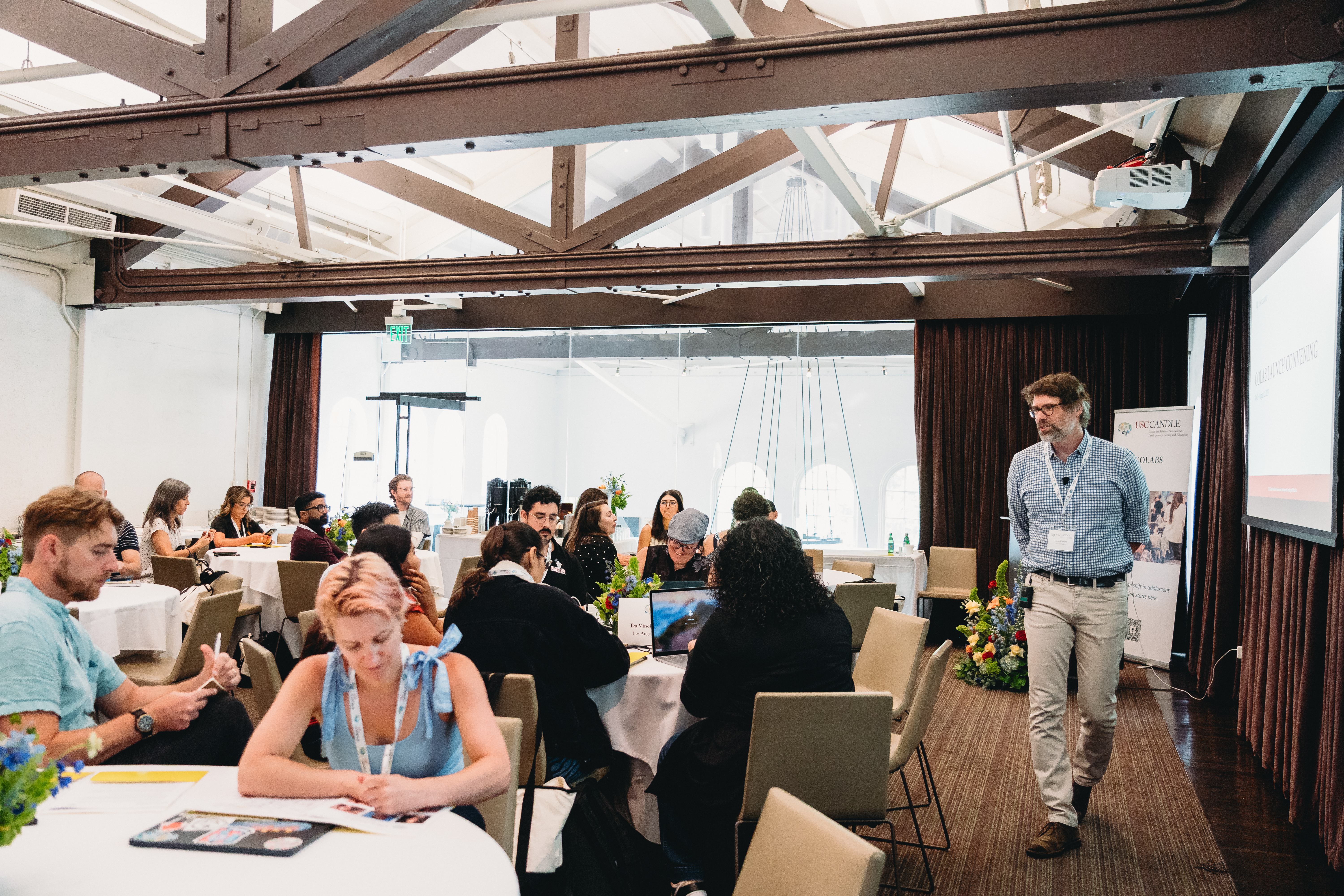
In the Scriptorium of the USC University Club on a recent August morning, there’s a sense of anticipation and excitement in the air. Middle and high school educators from across the United States have gathered with staff members of the USC Center for Affective Neuroscience, Development, Learning and Education (USC CANDLE) for the launch of the USC CANDLE Innovation Lab, which has been some six years in the making.
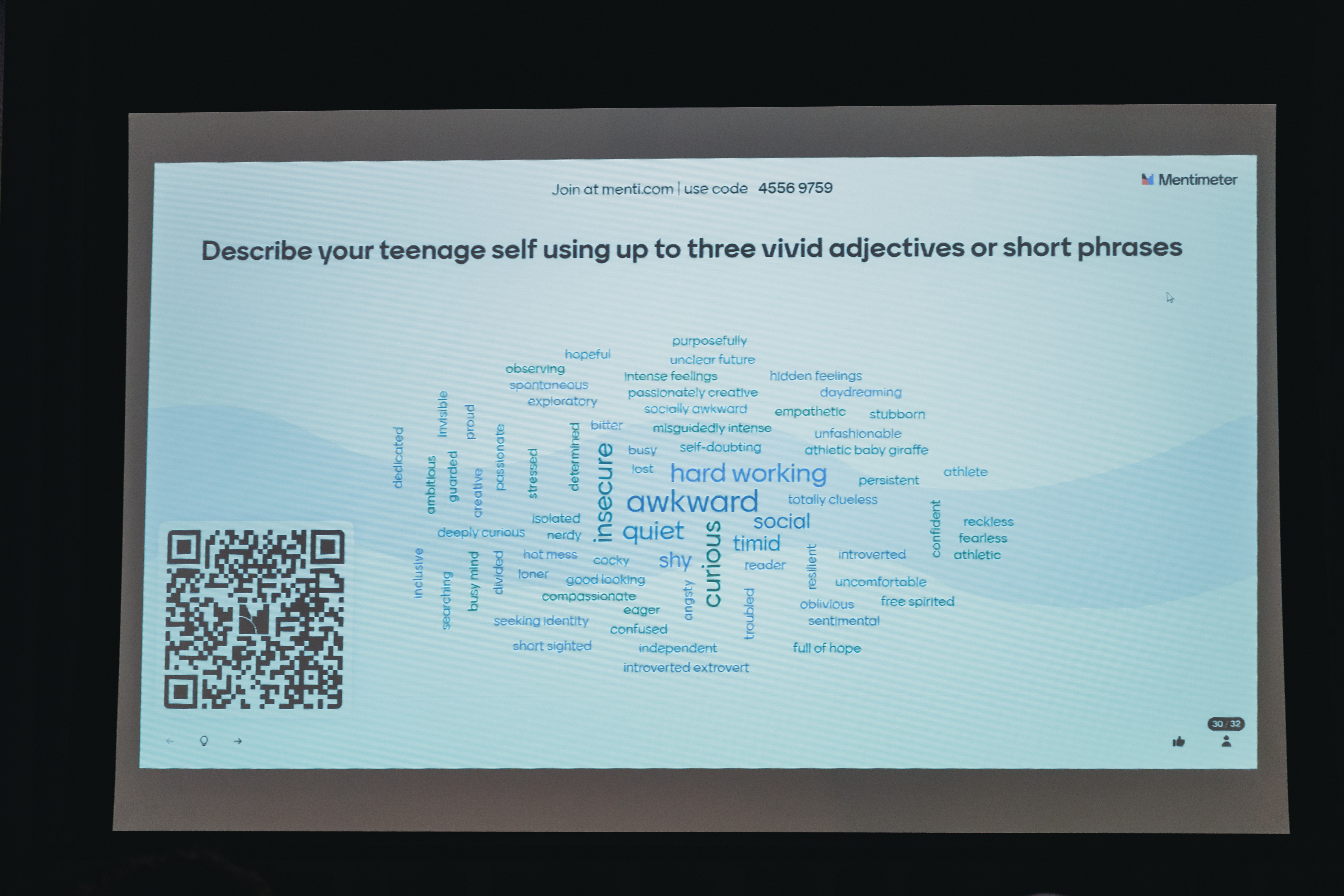
On this first morning together, USC CANDLE Senior Director of Educational Practice and Innovation Doug Knecht guides the group through an introduction, sets shared norms for the two-day launch event and has just introduced an icebreaker activity. It’s called “Teenage Me.” A chorus of “oohs” goes up from the room. Knecht asks the educators, who teach students ages 12 to 17, to think about their teenage selves and to input some adjectives into a word cloud.
As the cloud populates on a screen at the front of the room, some words stand out larger than others: “awkward,” “hardworking,” “insecure,” “quiet,” “curious.” Other phrases are smaller but memorable: “athletic baby giraffe,” “passionate creative,” “hot mess,” “loner,” “misguidedly intense.” After Knecht highlights a few of these descriptors, the educators share among their teams which words they chose to describe themselves, and a bit about their high school experiences.
As these educators get to know each other while opening up in a vulnerable way, it’s also a reminder of this project’s focus: adolescents. They discuss the emotions and struggles of being a teenager—the good, the bad and the uncomfortable parts that are unique to this age group but universal to everyone.
It’s an icebreaker, but also an opportunity for these educators to ponder what their students might be feeling and going through. Remembering how hard it is to be a teen, and what’s meaningful for that age group—how they make meaning of the world around them—can be useful for thinking about the people, activities and places that helped us learn and grow. It’s also helpful in brainstorming the ways in which USC CANDLE’s research on brain development can be transformed into actionable educational tools and techniques.
It all circles back to USC CANDLE’s groundbreaking work in researching the social and emotional development of adolescents—and the goals of the USC CANDLE Innovation Lab to develop methods for teachers and classrooms to support growth.
Funded by a two-year grant from the Bezos Family Foundation, the USC CANDLE Innovation Lab aims to bring cutting-edge neuroscience research on adolescent brain development into the classroom, while also bringing the realistic concerns of teachers and students back to the lab to refine USC CANDLE’s future research.
To do this, the center will work collaboratively with teams, or COLABs, of four or five teachers and one administrator from schools across the nation. The first cohort comes from the Beacon School in New York, Da Vinci RISE High in Los Angeles, the Institute for Collaborative Education in New York, John Muir Middle School in Burbank and Savanna High School in Anaheim.
Remembering how hard it is to be a teen, and what’s meaningful for that age group—how they make meaning of the world around them—can be useful for thinking about the people, activities and places that helped us learn and grow.
The Science
For over a decade, Mary Helen Immordino-Yang, the Fahmy and Donna Attallah Chair in Humanistic Psychology and founding director of USC CANDLE, has been leading groundbreaking research bridging neuroscience and education. Her work at USC CANDLE has pioneered the concept of “transcendent thinking” in adolescents, which has fundamentally reshaped how we understand learning and development in this age group.
At the center of Immordino-Yang’s research is the idea that it’s not simply facts memorized or skills mastered that helps young people’s brains grow over time, but how they think and feel about what they’re learning—with deep engagement, a sense of meaning and emotional connection. This expansion in the brain also spurs deep personal growth for the adolescents, which can lead to better life satisfaction and improved outcomes.
Using a transdisciplinary research methodology that combines qualitative interviews with teenagers (often from low-income and diverse communities) and fMRI brain imaging conducted over time, Immordino-Yang and her team of researchers have shown that when adolescents grapple with big ideas, strengthening their “transcendent thinking” skills—their capacity to reflect on experiences in ways that connect to broader ethical, social and cultural meaning—their brains physically develop in different ways. The team of USC CANDLE researchers have found that emotions, culture and context are central to learning and development, not peripheral.
For Immordino-Yang, giving teens a space to experience this development is the role of education, as we all “develop and emerge from our experiences,” she says. These types of educational experiences, which the COLABs are focused on creating, will help adolescents understand “the way it feels to think.”
USC CANDLE’s research underlines how crucial it is for middle and high schools to engage students in complex ways of thinking to support their brain development and mental health. It also demonstrates how important and helpful it is for educators to understand these neuroscientific findings so they can put them into practice in their classrooms. The goal of the COLABs is to foster a collaborative space for these educators to reimagine their curricula to create classroom environments where transcendent thinking is possible and encouraged.
Bringing It to Life
Immordino-Yang admits to the educators gathered at the USC University Club that she’s “ridiculously optimistic” when it comes to USC CANDLE’s mission of changing the world by reshaping education to prioritize human development through neuroscience. But her enthusiasm is infectious—and inspiring. Her goal is to make science work for the classroom, and she urges this inaugural cohort to remember that they are learning in service of something bigger, helping to facilitate students’ self-actualization over time.
Part of the excitement around the COLABs is in the unknown of this endeavor, the riskiness of trying something new that has a high potential for reward. To bridge the controlled environment of the lab and the uncontrolled environment of the classroom requires a “messy transdisciplinary approach,” Knecht says, as well as “deep, humble, intellectually curious” conversations on the educators’ part, according to Immordino-Yang.
The USC CANDLE team asks the educators to “re-see” what they’re witnessing in the classroom with a new understanding of adolescent brain development and to share reflections that can inform USC CANDLE’s research questions and conclusions.
Immordino-Yang admits to the educators gathered at the USC University Club that she’s “ridiculously optimistic” when it comes to USC CANDLE’s mission of changing the world by reshaping education to prioritize human development through neuroscience.
John Muir Middle School teacher Avetis Ovakimyan says one of his goals for the COLAB is to “learn a little bit more about how [students] are thinking and what it means to study on their level.” His colleague, Tara Sherman, notes that the study and support of adolescent brain development is a “missing piece” in the science of education, and that she’s excited to dive into the neuroscience to “be a better teacher for them—to bring them to the level and expectations that I know they can reach.”
Gabriela Stultz of the Institute for Collaborative Education in New York City adds, “It’s not just about making adaptations to your content and curriculum, but rather: How can we even the playing field by creating environments where all students feel like they can succeed, and to look at the role that that plays in their future success?”
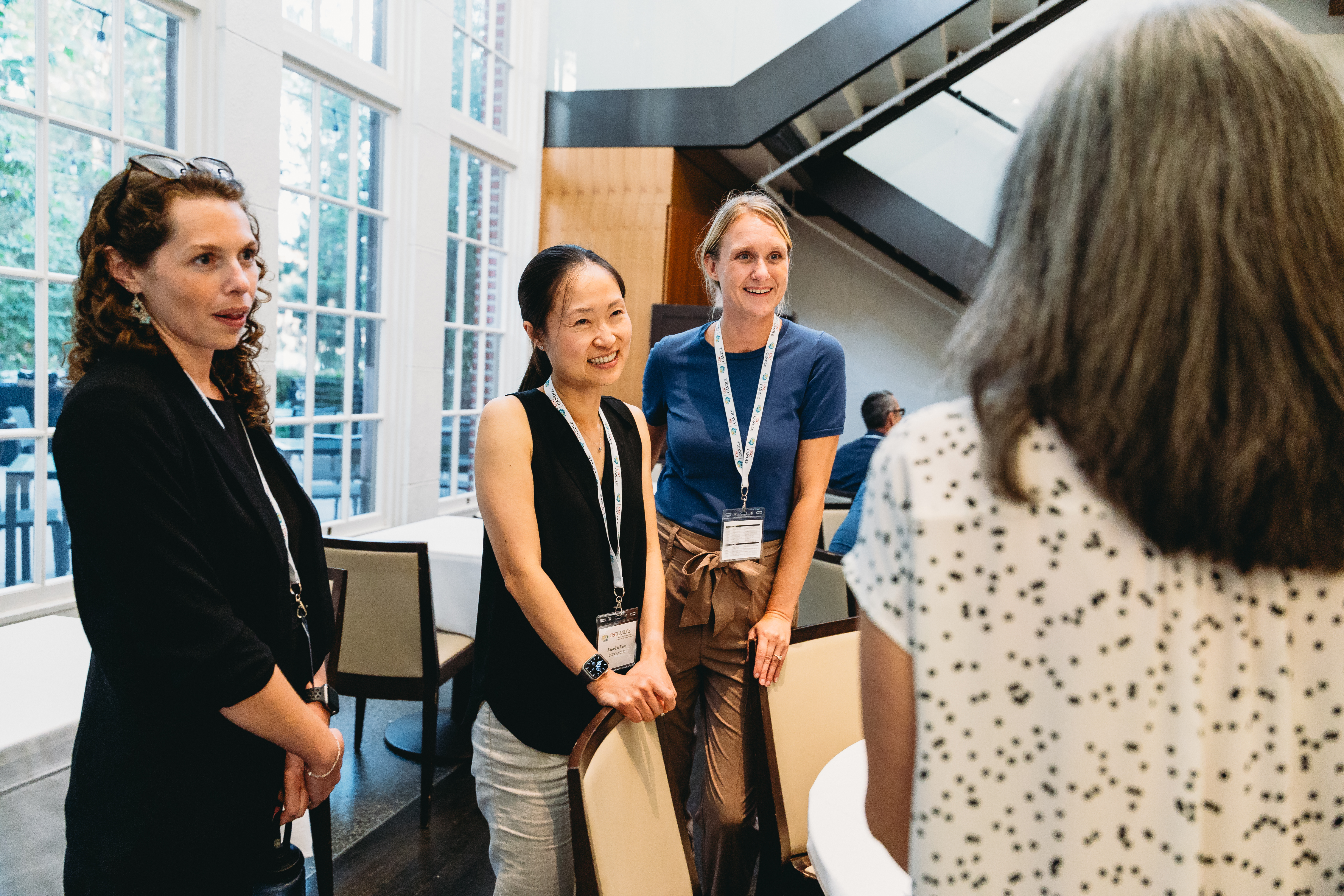
USC Rossier School of Education faculty members are just as excited about the possibility to learn more. Xiao-Fei Yang, associate research professor and scientific director of USC CANDLE, describes the COLAB project as “a dream come true—the motivation behind all the work that we do.” Trained as a neuroscientist, Yang shares a belief with Immordino-Yang that USC CANDLE’s research has the potential to change the world by supporting adolescent development. The COLAB project is the first big step to bringing their research into the classroom in a practitioner-led way.
The COLAB project is “the first systematic attempt to engage teachers with the science that we do,” says Yang. “We want to see how they use it.” Her goals are twofold: to see if their findings make a difference for adolescent development, but also to generate new research questions, specifically ones that could be useful for teachers.
The educators are a crucial part of this project, especially for Yang. “We know the science,” she says, “but that doesn’t translate to what do you do in the classroom. That’s why we really need the educators to think with us, because they’re the ones who are enacting the practice. They’re going to be the ones to figure out what to do in the classroom.”
Yang also has longer-term projects in mind, like a longitudinal study of both the participating teachers and their students. One question she’s pondering: “As the teachers are going through this conceptual change about their work, or the actual change in the pedagogy, in what ways do the students benefit?”
Knecht brings to the lab multiple experiences in education, having worked in an education nonprofit, as a high school science teacher, at the New York City Department of Education and in several leadership roles at the Bank Street College of Education. For a decade, he’s been looking for a way to work with Immordino-Yang after encountering some of her landmark research, which he could “almost immediately see having implications for the way schools are structured and classrooms work.”
As for the COLAB project, Knecht says, “This space is meant to open up something that I have not, frankly, experienced much of in my 30-year career, which is truly generative.” Knecht encourages patience and openness to the process; he knows it’s more than just an “intervention” to be implemented, because it’s designed to be collaborative, with educators bringing their own questions and concerns to the table.
“We think this group is going to help us figure out how to make use of [research findings], generate some interesting ways of querying the science and create some new, research-oriented pathways,” Knecht says.
“The opportunity to actively engage in brand-new research in education and in neuroscience is the coolest thing ever.” —Daniel Zucker, Science Teacher, Institute for Collaborative Education
Over the next year, the schools in this first COLAB cohort will continue to meet with the USC CANDLE team virtually to deepen their understanding of neuroscience in the classroom. They’ll then move on to the next phases of the project: designing frameworks to incorporate these key principles into the classroom, and then implementing and evaluating their innovations.
The excitement for what’s to come reverberates around the room at the two-day deep dive, and is echoed by Daniel Zucker of the Institute for Collaborative Education. “The opportunity to actively engage in brand-new research in education and in neuroscience is the coolest thing ever,” he says. “The opportunity to be invited to participate is such a positive feeling, affirming that we’re doing something right.”
Mary Helen Immordino-Yang
- Fahmy and Donna Attallah Chair in Humanistic Psychology
- Director, USC Center for Affective Neuroscience, Development, Learning and Education (candle.usc.edu)
- Professor of Education, Psychology & Neuroscience
- Brain & Creativity Institute; Rossier School of Education University of Southern California Member, U.S. National Academy of Education
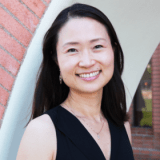
Xiao-Fei Yang
- Associate Research Professor